dijous, de juny 20, 2013

Decline and fall: how American society unravelled

http://www.guardian.co.uk/world/2013/jun/19/decline-fall-american-society-unravelled

Decline and fall: how American society unravelled

Thirty years ago, the old deal that held US society together started to unwind, with social cohesion sacrificed to greed. Was it an inevitable process – or was it engineered by self-interested elites?
  • The Guardian, 
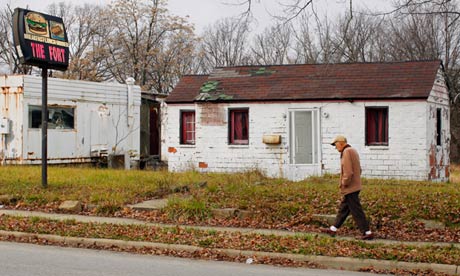
  • Ruined home in Youngstown, Ohio
Youngstown, Ohio, was once a thriving steel centre. Now, the industry has all gone and the city is full of abandoned homes and businesses. Photograph: Brian Snyder/Reuters
In or around 1978, America's character changed. For almost half a century, the United States had been a relatively egalitarian, secure, middle-class democracy, with structures in place that supported the aspirations of ordinary people. You might call it the period of the Roosevelt Republic. Wars, strikes, racial tensions and youth rebellion all roiled national life, but a basic deal among Americans still held, in belief if not always in fact: work hard, follow the rules, educate your children, and you will be rewarded, not just with a decent life and the prospect of a better one for your kids, but with recognition from society, a place at the table.
  1. The Unwinding
  2. by George Packer

This unwritten contract came with a series of riders and clauses that left large numbers of Americans – black people and other minorities, women, gay people – out, or only halfway in. But the country had the tools to correct its own flaws, and it used them: healthy democratic institutions such as Congress, courts, churches, schools, news organisations, business-labour partnerships. The civil rights movement of the 1960s was a nonviolent mass uprising led by black southerners, but it drew essential support from all of these institutions, which recognised the moral and legal justice of its claims, or, at the very least, the need for social peace. The Roosevelt Republic had plenty of injustice, but it also had the power of self-correction.
Americans were no less greedy, ignorant, selfish and violent then than they are today, and no more generous, fair-minded and idealistic. But the institutions of American democracy, stronger than the excesses of individuals, were usually able to contain and channel them to more useful ends. Human nature does not change, but social structures can, and they did.
At the time, the late 1970s felt like shapeless, dreary, forgettable years.Jimmy Carter was in the White House, preaching austerity and public-spiritedness, and hardly anyone was listening. The hideous term "stagflation", which combined the normally opposed economic phenomena of stagnation and inflation, perfectly captured the doldrums of that moment. It is only with the hindsight of a full generation that we can see how many things were beginning to shift across the American landscape, sending the country spinning into a new era.
In Youngstown, Ohio, the steel mills that had been the city's foundation for a century closed, one after another, with breathtaking speed, taking 50,000 jobs from a small industrial river valley, leaving nothing to replace them. In Cupertino, California, the Apple Computer Company released the first popular personal computer, the Apple II. Across California, voters passed Proposition 13, launching a tax revolt that began the erosion of public funding for what had been the country's best school system. In Washington, corporations organised themselves into a powerful lobby that spent millions of dollars to defeat the kind of labour and consumer bills they had once accepted as part of the social contract. Newt Gingrich came to Congress as a conservative Republican with the singular ambition to tear it down and build his own and his party's power on the rubble. On Wall Street, Salomon Brothers pioneered a new financial product called mortgage-backed securities, and then became the first investment bank to go public.
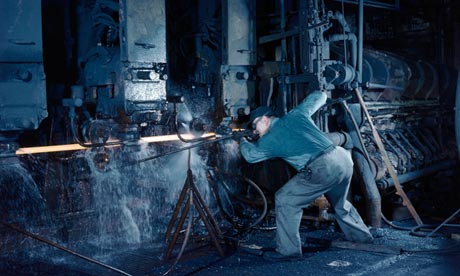
A steelworker in Youngstown, OhioA steelworker in Youngstown, Ohio, in 1947. Under the old deal, his hard work was to be rewarded. Photograph: Willard R. Culver/National Geographic/Corbis
The large currents of the past generation – deindustrialisation, the flattening of average wages, the financialisation of the economy, income inequality, the growth of information technology, the flood of money into Washington, the rise of the political right – all had their origins in the late 70s. The US became more entrepreneurial and less bureaucratic, more individualistic and less communitarian, more free and less equal, more tolerant and less fair. Banking and technology, concentrated on the coasts, turned into engines of wealth, replacing the world of stuff with the world of bits, but without creating broad prosperity, while the heartland hollowed out. The institutions that had been the foundation of middle-class democracy, from public schools and secure jobs to flourishing newspapers and functioning legislatures, were set on the course of a long decline. It as a period that I call the Unwinding.
In one view, the Unwinding is just a return to the normal state of American life. By this deterministic analysis, the US has always been a wide-open, free-wheeling country, with a high tolerance for big winners and big losers as the price of equal opportunity in a dynamic society. If the US brand of capitalism has rougher edges than that of other democracies, it is worth the trade-off for growth and mobility. There is nothing unusual about the six surviving heirs to the Walmart fortunepossessing between them the same wealth as the bottom 42% of Americans – that's the country's default setting. Mark Zuckerberg and Bill Gates are the reincarnation of Henry Ford and Andrew Carnegie, Steven Cohen is another JP Morgan, Jay-Z is Jay Gatsby.
The rules and regulations of the Roosevelt Republic were aberrations brought on by accidents of history – depression, world war, the cold war – that induced Americans to surrender a degree of freedom in exchange for security. There would have been no Glass-Steagall Act, separating commercial from investment banking, without the bank failures of 1933; no great middle-class boom if the US economy had not been the only one left standing after the second world war; no bargain between business, labour and government without a shared sense of national interest in the face of foreign enemies; no social solidarity without the door to immigrants remaining closed through the middle of the century.
Once American pre-eminence was challenged by international competitors, and the economy hit rough seas in the 70s, and the sense of existential threat from abroad subsided, the deal was off.Globalisation, technology and immigration hurried the Unwinding along, as inexorable as winds and tides. It is sentimental at best, if not ahistorical, to imagine that the social contract could ever have survived – like wanting to hang on to a world of nuclear families and manual typewriters.
This deterministic view is undeniable but incomplete. What it leaves out of the picture is human choice. A fuller explanation of the Unwinding takes into account these large historical influences, but also the way they were exploited by US elites – the leaders of the institutions that have fallen into disrepair. America's postwar responsibilities demanded co-operation between the two parties in Congress, and when the cold war waned, the co-operation was bound to diminish with it. But there was nothing historically determined about the poisonous atmosphere and demonising language that Gingrich and other conservative ideologues spread through US politics. These tactics served their narrow, short-term interests, and when the Gingrich revolution brought Republicans to power in Congress, the tactics were affirmed. Gingrich is now a has-been, but Washington today is as much his city as anyone's.
It was impossible for Youngstown's steel companies to withstand global competition and local disinvestment, but there was nothing inevitable about the aftermath – an unmanaged free-for-all in which unemployed workers were left to fend for themselves, while corporate raiders bought the idle hulks of the mills with debt in the form of junk bonds and stripped out the remaining value. It may have been inevitable that the constraints imposed on US banks by the Glass-Steagall Act of 1933 would start to slip off in the era of global finance. But it was a political choice on the part of Congress and President Bill Clinton to deregulate Wall Street so thoroughly that nothing stood between the big banks and the destruction of the economy.
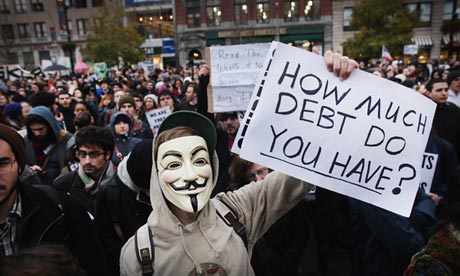
Occupy Wall Street protesterOne of the 99%: an Occupy Wall Street protester in Union Square, New York, in 2011. Photograph: Spencer Platt/Getty Images
Much has been written about the effects of globalisation during the past generation. Much less has been said about the change in social norms that accompanied it. American elites took the vast transformation of the economy as a signal to rewrite the rules that used to govern their behaviour: a senator only resorting to the filibuster on rare occasions; a CEO limiting his salary to only 40 times what his average employees made instead of 800 times; a giant corporation paying its share of taxesinstead of inventing creative ways to pay next to zero. There will always be isolated lawbreakers in high places; what destroys morale below is the systematic corner-cutting, the rule-bending, the self-dealing.
Earlier this year, Al Gore made $100m (£64m) in a single month by selling Current TV to al-Jazeera for $70m and cashing in his shares of Apple stock for $30m. Never mind that al-Jazeera is owned by the government of Qatar, whose oil exports and views of women and minorities make a mockery of the ideas that Gore propounds in a book or film every other year. Never mind that his Apple stock came with his position on the company's board, a gift to a former presidential contender. Gore used to be a patrician politician whose career seemed inspired by the ideal of public service. Today – not unlike Tony Blair – he has traded on a life in politics to join the rarefied class of the global super-rich.
It is no wonder that more and more Americans believe the game is rigged. It is no wonder that they buy houses they cannot afford and then walk away from the mortgage when they can no longer pay. Once the social contract is shredded, once the deal is off, only suckers still play by the rules.
George Packer's The Unwinding is published by Faber & Faber at £20

diumenge, de juny 09, 2013

Jeremy Greenstock: «Si està pactat, Catalunya serà reconeguda a l'ONU»

http://www.naciodigital.cat/noticia/55790/jeremy/greenstock/si/esta/pactat/catalunya/sera/reconeguda/onu


ACN | Actualitzat el 09/06/2013 a les 10:55h

Jeremy Greenstock: «Si està pactat, Catalunya serà reconeguda a l'ONU»

L'exambaixador britànic de l'ONU avisa que si Espanya continua "resistint-se a un canvi" els catalans tindran "indubtables dificultats"

L'exambaixador britànic davant de l'ONU i president de l'associació UNA-UK, Jeremy Greenstock. Foto: ACN

 Catalunya no tindrà "cap problema" per ser reconeguda a l'ONU si esdevé independent a través d'un procés acordat amb l'Estat, però patirà "indubtables dificultats" si Madrid prohibeix el referèndum o l'ignora. Aquesta és l'opinió del diplomàtic britànic Jeremy Greenstock, exambaixador del Regne Unit a les Nacions Unides i president de l'UNA-UK. En una entrevista a l'ACN, Greenstock assegura que l'autodeterminació genera "simpaties" a les Nacions Unides, però admet que els seus membres tenen "un sentiment encara més fort" de "respecte" per la sobirania dels estats tradicionals. Si Madrid digués a tothom de fora 'perdeu-vos, marxeu, aquest és un afer nostre', ho hauríem de respectar", reconeix.
 
Jeremy Greenstock, que va ser l'ambaixador del Regne Unit davant de les Nacions Unides entre el 1998 i el 2003 després d'una carrera diplomàtica de 35 anys, assegura que "diversos països d'arreu d'Europa i d'arreu del món podrien votar diferent a l'ONU", reconeix el diplomàtic, que afegeix: "Catalunya necessitaria el suport d'altres nacions per ser reconeguda a l'ONU com un nou estat".
 
El control, però, el té Madrid, com admet el propi Greenstock. "Des del meu punt de vista, Catalunya no pot assenyalar cap principi o article constitucional que li doni el dret a l'autodeterminació, i l'ONU no li dóna el dret a separar-se d'Espanya", defensa. Considera a més que els catalans tenen "una revindicació moral" però no necessàriament "un dret" a l'autodeterminació, i hauran d'argumentar la necessitat del referèndum i de la independència "des del punt de vista de la justícia del seu cas, d'acord amb la situació moral del que és legítim per l'ONU", afirma. Escòcia, assegura, estava en la mateixa situació però el Regne Unit "té una base democràtica suficient i una història de negociacions" que ha permès acordar la consulta. 
 
Greenstock assegura que a nivell internacional la situació a Catalunya "s'està observant": "Però el govern espanyol no permetrà que se'n parli formalment sota cap marca de l'ONU". "Veig que hi haurà dificultats considerables pel Regne d'Espanya en acordar la independència de Catalunya, perquè podria afectar l'estabilitat futura del que quedaria de l'estat", observa l'exambaixador britànic. 
 
Si les converses entre Catalunya i Espanya s'estanquen, l'ONU podria actuar com a mediadora, assegura Greenstock. "Qualsevol país té el dret d'utilitzar els serveis de l'ONU d'aquesta manera, però em resulta difícil imaginar que Madrid iniciés aquest tipus de petició, i Catalunya no pot perquè no és membre de les Nacions Unides", reconeix. "En teoria és possible, però hi ha dificultats. Catalunya té pocs drets internacionals fora del Regne d'Espanya", sentencia el diplomàtic britànic. 


La Mati conchuda xD


Noche de rooooock


dimecres, de juny 05, 2013

Concert per la llibertat!!!!


Concert per la llibertat

Contingut artístic

El Concert per la Llibertat és un espectacle inèdit que farà un recorregut per diverses cançons que formen part de l’imaginari col•lectiu del país i d’arreu del món que han servit per reclamar la llibertat de les persones i dels pobles. Entre aquestes cançons n’hi ha algunes de les més emblemàtiques de Lluís Llach, interpretades pel propi autor i per artistes de diversos països i diverses generacions.
La direcció artística i escenogràfica del Concert per la Llibertat és a càrrec de Lluís Danés i Gerard Quintana.
La direcció musical anirà a càrrec de Carles Cases, Dani Espasa i Xavi Lloses.
ARTISTES QUE HI PARTICIPARAN:
Alessio Lega
Andreu Rifé
Amadeu Casas
Beth
Bikimel
Carl Carlton
Carles Santos
Castellers de Vilafranca
Cesk Freixas
Companyia Elèctrica Dharma
Cobla de Cambra de Catalunya
Cris Juanico
David Alegret
Dyango
Fermín Muguruza
Ferran Piqué (Els Amics de les Arts)
Franca Masu
Gerard Quintana
Gorka Knörr
Gossos
Grup de Folk
Ivette Nadal
Joan Amèric
Joan Dausà
Joan Isaac
Joan Pau Cumellas
Joana Serrat
Jofre Bardagí
Jordi Batiste
Lídia Pujol
Lluís Llach
Maria del Mar Bonet
Marina Rossell
Mayte Martín
Mercedes Peón
Miquel Gil
Mouss & Hakim
Nena Venetsanou
Núria Feliu
Orfeó Català
Orquestra Simfònica de Barcelona i Nacional de Catalunya (OBC)
Paco Ibáñez
Pascal Comelade
Pastora
Pau Alabajos
Pedro Guerra
Pep Sala
Pere Jou (Quart Primera)
Peret
Projecte Mut
Quico Pi de la Serra
Sabor de Gràcia
Sopa de Cabra
Titot i David Rosell (Brams)
Xarim Aresté (Very Pomelo)
Yacine Belahcene
Yannis Papaiannou

dimarts, de juny 04, 2013

Los vástagos del poder: frivolidad que insulta

Los vástagos del poder: frivolidad que insulta

http://www.proceso.com.mx/?p=343489

La prepotencia y la impunidad, vestidas con el ropaje de la frivolidad, se constituyen en una de las nuevas plagas del país y vienen de la mano de los hijos de los oligarcas de viejo y nuevo cuño. Los júniores del poder político y económico son huéspedes frecuentes de las llamadas revistas del corazón, pero también sus andanzas son ampliamente ventiladas en las redes sociales. En esos medios exhiben su insultante riqueza –de origen difícil de justificar– y también sus trapacerías, que así son sometidas al inmediato juicio popular.

Por Tomado de: / Arturo Rodríguez / Proceso

Dia de publicación: 2013-05-31


MÉXICO, D.F. (Proceso).- Como si se tratara de una nobleza a la mexicana, quienes forman parte de los clanes del poder provienen de grupos elitistas de diverso signo. Los vástagos de la clase política se juntan, se emparientan, se asocian. Y además compiten por las portadas de las llamadas revistas del corazón, en cuyas páginas suelen desplegarse sus vidas y “gracias”.
Pero toda esa frivolidad, todo este usufructo de riquezas y prebendas adquiridas por sus genearcas les comienzan a pasar la factura: Las redes sociales hacen eco de sus excesos, lujos y arbitrariedades.
En lo que va del gobierno de Enrique Peña Nieto, la mala conducta de los júniores y sus resonancias en las redes sociales ya ocasionaron la destitución de un funcionario y un posicionamiento de la Procuraduría General de la República (PGR) en torno a un asunto familiar de su titular, Jesús Murillo Karam.
El pasado 26 de abril Andrea Benítez, hija de Humberto Benítez Treviño, entonces titular de la Procuraduría Federal del Consumidor (Profeco), hizo un berrinche: Molesta porque en el restaurante Maximo Bistrot no le asignaron la mesa que deseaba, ordenó a inspectores de la dependencia que encabezaba su papá que clausuraran el lugar. Varios servidores públicos, solícitos, la obedecieron.
Benítez Treviño es un político de la élite mexiquense. En el sexenio de Carlos Salinas de Gortari fue procurador general de la República. Entre los numerosos cargos que ha desempeñado en su larga trayectoria destaca el de secretario general de Gobierno en el Estado de México, cuando el gobernador era Enrique Peña Nieto. Esta cercanía le aseguró la designación en la Profeco.
Tras el escándalo de Andrea (Lady Profeco), su padre fue destituido. El jueves 9 Papá Profeco, como se le conoció en las redes, concitó el repudio de los cibernautas al declarar que jamás consideró renunciar. El miércoles 15 el secretario de Gobernación, Miguel Ángel Osorio Chong, anunció su cese por instrucciones del presidente.
A decir de Osorio, el mandatario consideró que el escándalo dañó la imagen y el prestigio de la institución. Su remoción, añadió, es un mensaje para los servidores públicos, quienes además de cumplir la ley deben desempeñarse con ética y profesionalismo.
Aún no se reponía la administración peñista del escándalo Benítez cuando otro caso comprometió la imagen del gabinete de seguridad, pues la hija del director del Centro de Información y Seguridad Nacional (Cisen), Eugenio Ímaz Gispert, denunció en las redes sociales que el nieto del titular de la PGR, Jesús Murillo Karam, le había propinado una golpiza.
El lunes 20 Alexia Ímaz publicó en Twitter varias fotografías: En dos de ellas su ojo derecho mostraba un severo hematoma; en la parte superior, la imagen de Gerardo Saade Murillo, el agresor.
“Gerardo Saade, golpeador de mujeres. La violencia contra la mujer es un delito. Denuncien”, escribió Alexia. Su hermana María comentó, también en Twitter que Saade brincó la barda de su domicilio en Cuernavaca y golpeó a su víctima, sorprendiéndola mientras dormía.
La imagen circuló durante un día y medio en las redes sociales hasta que la noche del martes 21 la PGR admitió los hechos en un comunicado. Aunque aclaró que no intervendría por tratarse de un asunto del fuero común.
El miércoles 22 el diario Reforma dio a conocer que Alexia Ímaz acudió al Ministerio Público el día de los hechos, pero ya en el lugar se desistió de hacer la denuncia.
Las redes sociales
Como en el caso de la golpiza propinada a Alexia Ímaz, son los propios hijos de los poderosos quienes desatan escándalos por lo que dicen y publican en sus cuentas de Twitter y Facebook.
Desde la precampaña, cuando Enrique Peña Nieto era víctima de sí mismo y lo exhibían en las redes sociales, luego de que le fallaron los conocimientos bibliográficos en la Feria del Libro de Guadalajara, su hija Paulina desató el escándalo #soyprole.
La hija del hoy presidente, adolescente aún, tuvo el mal tino de retuitear el mensaje clasista y discriminatorio que escribió su novio José Luis Torre, a propósito de las críticas a Peña Nieto que en la red social enfrentaba el hashtag #libreríapeñanieto:
“Un saludo a toda la bola de pendejos, que forman parte de la prole y solo critican a quien envidian (sic)”.
Peña Nieto tuvo que pedir disculpas por “la reacción emotiva” de su hija, e inclusive la esposa del mandatario, Angélica Rivera salió al quite.
Por cierto, Sofía Castro, hija de Angélica Rivera, desató otro escándalo en noviembre pasado cuando declaró con ingenuidad a Gente, suplemento del diario Reforma, que usaba zapatos de 15 mil pesos comprados por su padre, José Alberto Castro, como premio por acudir un mes al gimnasio.
Familia presidencial aparte, otra nobleza se ha configurado en el ámbito sindical, que tiene como caso paradigmático el de los hijos del dirigente del sindicato petrolero, Carlos Romero Deschamps.
El caso de Paulina Romero también fue dado a conocer por Reforma en mayo de 2012, cuando el rotativo descubrió en Facebook lo que calificó como “diario de viajes”. Viajes alrededor del mundo en vuelos comerciales y privados, acompañada de sus tres mascotas. Comidas en exclusivos restaurantes rociadas con champaña y vinos Vega Sicilia. Como una muestra de su guardarropa presumió sus bolsos Hermes de 12 mil dólares, a los que ella se refirió como “sus bolsas de Superama”.
El pasado 23 de febrero el portal electrónico de Proceso dio a conocer que Romero Deschamps regaló a su hijo José Carlos un Ferrari de edición limitada valuado en dos millones de dólares.
“Para adquirirlo es necesario contar por lo menos con dos vehículos Ferrari, demostrar solvencia económica, que el país donde vaya a circular el auto cuente con una agencia automotriz de esa marca, someterse a una sofisticada prueba de manejo y por supuesto pagar la unidad”, se explicó en la nota.
Recientemente Reforma dio seguimiento a las propiedades de José Carlos en Miami, Florida, y pudo documentar que posee dos departamentos con valor de 7.5 millones de dólares.
Líos judiciales
En ocasiones los líos de los hijos del poder llegan a los tribunales, aunque no se les condena. Un caso, expuesto en su tiempo en medios de comunicación, mantiene enfrentando procesos legales a Jorge Kahwagi, boxeador, personaje de la farándula, político e hijo del empresario del mismo nombre.
Se trata de un pleito añejo con el empresario textil Alfredo Karam, propietario también de Préstamos Karam. En 1999 le prestó a Kahwagi un millón y medio de pesos para que pagara una deuda que tenía con Alejandro Peralta, hermano de Carlos Peralta, descendiente del empresario Alejo Peralta.
Cuando intentó cobrar, Karam fue brutalmente golpeado por el boxeador quien –según el agredido– se valió de las influencias de su padre para meterlo a la cárcel seis meses acusándolo de fraude procesal, hasta que un tribunal constitucional le otorgó un amparo definitivo.
El empresario textilero asegura que recibió muchas presiones, entre éstas el secuestro de su esposa a quien los Kahwagi obligaron a firmar documentos con el propósito de forzarlo a desistirse de cualquier acción legal.
Sin embargo sigue haciendo gestiones. Tras documentar que el agresor-deudor no respondió en tiempo y forma a la primera demanda, así como de acreditar que se falsificó un documento notarial, inició un proceso que pretende declarar nulas las sentencias favorables a Kahwagi.
El pasado 8 de abril se realizó la primera audiencia del juicio de nulidad y, un mes después, el lunes 6, Kahwagi ya estaba metido en otro lío: Un hombre lo acusó de golpear a su hija, quien supuestamente mantiene una relación sentimental con el pugilista. Éste se limitó a negar los hechos en su cuenta de Twitter.
Jorge Kahwagi inició su carrera política en el Partido Verde Ecologista de México (PVEM) y luego pasó al Panal, del cual fue presidente nacional. Todo ello de la mano de Jorge Emilio González Martínez, cuyo padre, Jorge González Torres, es hermano de Víctor Doctor Simi y de Enrique, exrector de la Universidad Iberoamericana. Por si le faltara prosapia, Jorge Emilio es nieto del doctor Emilio Martínez Manautou, viejo amigo de Gustavo Díaz Ordaz y quien ocupó la Secretaría de Salubridad y Asistencia en el sexenio de López Portillo y luego fue gobernador de Tamaulipas.
Conocido como El Niño Verde, en 2001 González Martínez heredó de su papá un partido político: el PVEM. De éste fue presidente hasta hace poco. En 2004 se vio implicado en un videoescándalo en el que se le mostraba recibiendo un soborno para ayudar a liberar una zona natural en Cancún protegida por leyes ambientales.
Años después, en 2011, se le implicó en la muerte de Galina Chankova, una joven que cayó desde el piso 19 de un edificio que supuestamente pertenece al Niño Verde. Él negó que estuviera en el sitio el día de la muerte y que el inmueble sea de su propiedad.
Actual senador y coordinador de la bancada del Partido Verde, González Martínez tuvo su escándalo más reciente el pasado 17 de febrero cuando lo detuvieron por conducir en estado de ebriedad y lo encerraron durante unas horas, hasta que sus abogados tramitaron un amparo. Después regresó, aceptó que cometió un error y dijo que estaba dispuesto a cumplir las horas que le faltaban de encierro. Esto fue ampliamente comentado en las redes sociales.
El 29 de mayo de 2012, durante los días de mayor fuerza del movimiento #yosoy132, el diario El Universal publicó una declaración del Niño Verde a propósito de los jóvenes que participaban en las protestas… y desató más reacciones en las redes sociales: “Creo que es hora de que estos ‘ninis’ hagan algo por el país. Que hagan algo productivo para ellos. Que se dediquen a trabajar”.